

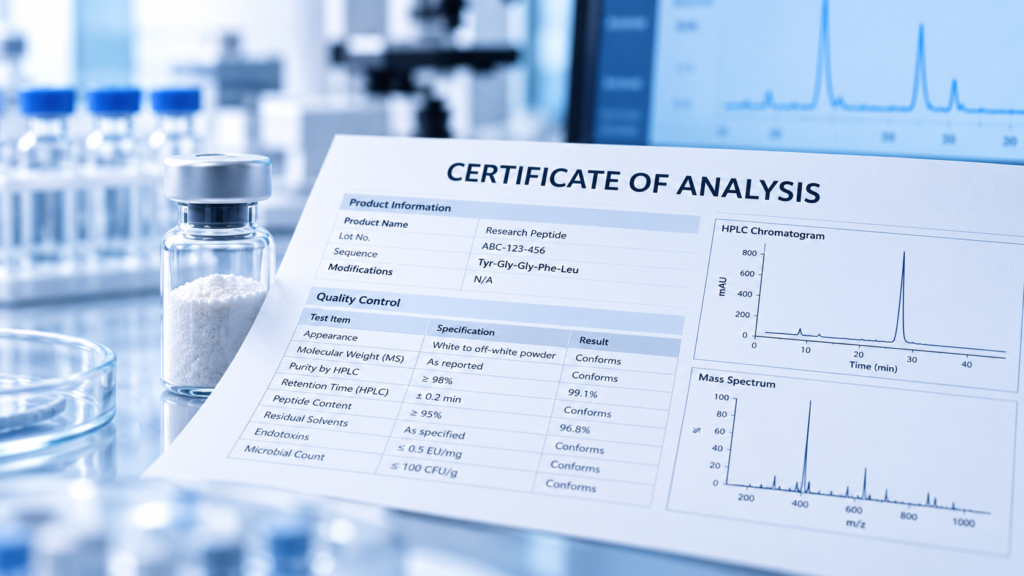
Introduction
A Certificate of Analysis (COA) is a document that records the results of specified tests performed on a product or sample. In peptide research, it may include information about product identity, measured purity, molecular mass, content and selected quality parameters.
For healthcare professionals and researchers, understanding how to interpret a COA is an important part of reviewing product documentation. However, the presence of a certificate does not automatically establish that every aspect of a product has been independently verified.
This guide explains the main sections of a peptide COA, how to compare specifications with reported results, and what to consider when reviewing supporting laboratory data.
A sample Epitalon COA is used to illustrate the terminology and figures discussed below. The figures are examples transcribed from the supplied document, not independent verification of the product or its test results.
What Is a Certificate of Analysis?
A COA summarises the outcome of specified analytical or quality-control tests against stated criteria. Its scope depends on the tests performed, the methods used and the organisation that issued the document.
A typical peptide COA may contain three main elements:
- Product identification: The product name, batch or lot number, sequence and any stated modifications.
- Quality-control results: The tests performed, the specifications applied and the reported findings.
- Supporting analytical data: Chromatograms, mass spectra, method details and other records relevant to the tests.
These sections should be considered together. A result is most useful when it can be connected to a clearly identified sample, an appropriate analytical method and a defined acceptance criterion.
How to Read the Main Sections of a COA
1. Product name, sequence and lot number
Start by checking the identity information at the top of the certificate.
The product name identifies the material described in the document. Where a peptide sequence is supplied, it provides additional information about the stated amino acid composition and order. Modifications, where present, should also be documented because they may affect the identity and analytical characteristics of a molecule.
The lot or batch number is particularly important for traceability. It links the certificate to a specific batch rather than to a product name in general.
In the supplied Epitalon example, the lot number is CLB-EPT-251010-01-50. This same identifier appears in the supporting analytical pages. Matching identifiers help establish documentary consistency, although they do not independently prove that the tested sample came from the physical material supplied.
2. Specifications versus results
The quality-control table typically contains three columns: the test item, the specification and the result.
The specification describes the stated acceptance criterion. The result records what the certificate reports for that test. These are different pieces of information and should not be confused.
Consider the following examples from the supplied COA:
| Test item | Specification | Reported result |
|---|---|---|
| HPLC purity | Greater than 98% | 98.6% |
| Molecular weight | 390.35 ± 1.0 Da | 389.95 Da |
| Net peptide content | At least 50 mg | 55.7 mg |
| Acetic acid content | No more than 8.0% | 5.2% |
These figures illustrate how a result can be compared with its stated criterion. For example, the reported molecular weight falls within the numerical range specified in the document.
This comparison establishes only whether the reported figure meets the stated criterion. It does not establish whether the specification itself is sufficiently rigorous, whether the method is suitable, or whether the result has been independently confirmed.
3. HPLC purity
High-performance liquid chromatography (HPLC) is an analytical technique used to separate components within a sample. A detector records signals as components pass through the system, producing a chromatogram.
A COA may report a purity percentage calculated from the relative areas of peaks in that chromatogram. In the supplied example, the reported HPLC purity is 98.6%. The supporting peak table identifies a principal peak with an area percentage of 98.553%, consistent with the rounded figure in the summary table.
It is important to understand what this number represents. An HPLC area percentage is method-dependent and does not necessarily represent the percentage of the entire sample that consists of the intended peptide by mass.
The result should be interpreted in the context of the method, detector, integration settings, separation of relevant components and the limitations of the analysis. A high reported area percentage does not, by itself, establish identity, absolute content or the absence of every possible impurity.
4. Molecular weight and mass spectrometry
Mass spectrometry (MS) measures the mass-to-charge ratios of detected ions. It can provide evidence that is useful when assessing whether a measured molecular mass is consistent with an expected value.
In the supplied COA, the theoretical molecular weight is 390.35 Da and the observed value is 389.95 Da. The certificate’s stated acceptance range is 390.35 ± 1.0 Da.
The observed value falls within that range. This is a numerical comparison of the figures reported in the document, not an independent confirmation of the sample’s identity.
Mass spectrometry results need to be interpreted using the relevant ion assignment, instrument method and expected molecular characteristics. A matching mass alone may not distinguish between all possible structures or establish the complete identity of a substance.
5. Content, residual solvents and other tests
Other COA entries describe different attributes and should be read individually.
Net peptide content records the stated amount of peptide in the sample. In the example, the reported result is 55.7 mg against a specification of at least 50 mg. The meaning of this result depends on the method used to determine content and how the sample was prepared and measured.
Residual solvent testing addresses specified solvents that may be associated with manufacturing or processing. The example lists dichloromethane (DCM) and dimethylformamide (DMF), both reported as “N.D.” This abbreviation commonly means “not detected” under the method used. It does not necessarily mean that absolutely none is present; interpretation depends on the method’s detection capability and reporting criteria.
The certificate also lists acetic acid and trifluoroacetic acid (TFA) content. These entries should be assessed against their individual specifications rather than treated as interchangeable measures of purity.
Microbiological and endotoxin tests address different parameters from chemical purity. The example reports total aerobic count, yeast and mould count, and endotoxins as conforming to the listed specifications. Because the summary uses “Conforms” rather than numerical results for these entries, the reader cannot determine the actual measured values from that table alone.
Reviewing Supporting Analytical Data
Chromatograms and peak tables
A chromatogram provides more context than a single summary percentage. Reviewers can examine the reported peaks, retention times and integration data, where available.
The supplied example includes an HPLC chromatogram and a peak table on page two. These support the reported purity figure, but the image alone does not establish that every relevant component was detected or adequately separated.
Mass spectra
The third page of the example contains a mass spectrum and lists theoretical and observed molecular weights. These records provide additional context for the molecular-weight result.
When reviewing supporting data, check that the product and lot identifiers match the certificate and that the reported values are consistent with the summary. If the method, sample identity or interpretation is unclear, further documentation may be needed.
Dates, storage and authorisation
Check the report date, manufacturing date, stated expiry date and storage conditions. In the supplied example, the report date is 17 October 2025, the manufacturing date is 10 October 2025, and the stated storage condition is −20°C.
These are the conditions and dates recorded in that document. They should not be taken as independently verified storage history or proof that the stated expiry period has been substantiated.
Where relevant, also establish who issued the COA, whether the testing laboratory can be identified, what quality system applies, and whether the document’s authenticity and the scope of testing can be verified.
Practical Considerations for Practitioners
What a COA can and cannot establish
A COA can provide a useful record of specified analytical results. Its evidential value depends on the reliability of the source, the suitability of the methods, the quality of the supporting records and the scope of the tests performed.
A COA should not automatically be treated as proof of clinical efficacy, safety, sterility, suitability for human use or compliance with every applicable regulatory requirement. Those conclusions require evidence appropriate to the specific question.
A simple review checklist
Before relying on a COA as part of a documentation review, consider the following:
- Does the product name and lot number match the material and associated records?
- Are the specifications clearly stated and the results interpretable?
- Are the analytical methods and supporting data available where needed?
- Do the chromatogram, peak table and mass spectrum align with the summary?
- Are terms such as “N.D.” and “Conforms” explained sufficiently?
- Is the issuing organisation identifiable, and can the document’s authenticity be checked?
- Are the limitations of the reported tests understood?
The answers help determine what the document supports and where additional evidence may be required.
Conclusion
A Certificate of Analysis is best understood as a record of specified tests, not as a blanket assurance about a product. Reading it carefully means checking the product and lot identification, understanding each specification and result, and interpreting supporting analytical data within the limits of the methods used.
For practitioners reviewing peptide documentation, the key is to distinguish between what the certificate reports, what the analytical evidence can support, and what remains unverified. A structured review helps make that distinction clear.
References
- Epitalon Certificate of Analysis supplied as the worked example for this article. Three-page document, including quality-control summary, HPLC chromatogram and peak table, and mass spectrum. Report date: 17 October 2025.
- United States Pharmacopeia (USP). General Chapter <621>, Chromatography. Refer to the applicable edition for information on chromatographic procedures and related requirements.
- United States Pharmacopeia (USP). General Chapter <1225>, Validation of Compendial Procedures. Refer to the applicable edition for principles relating to analytical procedure validation.
- International Union of Pure and Applied Chemistry (IUPAC). Compendium of Chemical Terminology (the Gold Book). Available at: https://goldbook.iupac.org/
This article is for educational purposes and intended for healthcare professionals. It does not establish product safety, clinical efficacy or suitability for human use.